
False Ceiling & Lighting for Dhaka Flats: Types & Cost
Explore false ceiling and architectural lighting types, cost factors, and ideas for Dhaka flats. Plan smarter and talk to Intro Space.
False Ceiling & Architectural Lighting: Types, Cost & Ideas for Dhaka Flats
Picture a typical Dhaka living room at 8 p.m. One tube light sits in the middle, a ceiling fan wobbles beside it, and a faint stain marks where the upstairs bathroom once leaked. The room works, but it feels flat.
That’s the problem a false ceiling solves, especially when you pair it with good lighting. This article covers false ceiling and architectural lighting for Dhaka flats: the types, what drives the cost, and ideas that suit our heat, humidity, and power supply. I’ll also tell you when to skip it.
What Is a False Ceiling?
A false ceiling, also called a drop or suspended ceiling, is a second ceiling fixed below the structural concrete slab. It hides wiring, pipes, and uneven concrete. It also gives you space to install recessed and concealed lights.
Most people think of it as decoration. I’d say the practical side matters more. It’s where your wiring, AC piping, and light fixtures live.
What Is Architectural Lighting?
Architectural lighting is light built into the structure of a room. Think ceiling coves, recessed downlights, wall washers, and LED profiles. Unlike a floor lamp, you plan it together with the ceiling and walls, so the fixtures stay hidden and the glow looks intentional.
This is the difference between a room that’s simply bright and a room that feels good to sit in.
Is a False Ceiling Worth It in Your Flat?
Not always. Let me be straight about that.
It’s usually worth it when:
- Your wiring or AC pipes are messy and visible
- You want cove lighting or a layered lighting plan
- Your slab has beams or uneven patches you’d like to hide
- You own the flat and plan to stay for years
I’d think twice, or skip it, when:
- Your ceiling is already on the lower side
- You rent, and your landlord hasn’t agreed
- An upstairs leak hasn’t been fixed yet
- Your budget is tight, and plain paint plus a couple of good lamps would do
A common scenario in Dhaka flats: someone installs a beautiful ceiling, and a few monsoons later, a hidden leak makes the board sag. Fix the source first. Decorate second.
Types of False Ceilings for Dhaka Flats
You have five realistic options. Each one behaves differently in our humid weather.
Gypsum Board
This is the most popular choice for living rooms and bedrooms. The surface is smooth and paintable, and it bends easily into coves, steps, and curves.
The catch is moisture. Standard gypsum board doesn’t like constant dampness. For kitchens or areas near bathrooms, ask for moisture-resistant board and galvanized framing, because cheap steel rusts.
Plaster of Paris (POP)
POP is the traditional route. It suits carved or classic designs, and some people love the hand-finished look.
It’s heavier, and it’s slower because of wet work. Poor workmanship often shows up as cracks along the joints. I’d choose it only when the design truly needs it.
PVC Panels
PVC panels are light and quick to install. Water doesn’t harm them, so they make sense for balconies, kitchens, and utility areas.
Cheap panels can look plasticky. A good one looks tidy and lasts. A bad one yellows and warps.
Grid Ceilings (Mineral Fiber or Metal Tiles)
You see these mostly in offices. Tiles lift out easily, so servicing wiring or ducts is simple.
In a home, they can feel commercial. I’d keep them for home offices or service areas, not for a living room.
Wood or WPC Panels
These add warmth and texture, and they photograph well. They also cost more, and moisture treatment matters a lot here.
I like them as a feature section over a dining table or entry, not across the whole flat.
Quick Comparison
| Type | Best For | Humidity Behavior | Watch Out For |
|---|---|---|---|
| Gypsum board | Living room, bedroom, dining | Fair; use moisture-resistant board in damp zones | Rusty cheap framing, poor joint finishing |
| POP | Classic or detailed designs | Fair | Joint cracks, slower work |
| PVC panels | Kitchen, balcony, utility | Very good | Cheap panels warp or yellow |
| Grid tiles | Home office, service areas | Depends on tile type | Commercial look |
| Wood/WPC | Feature sections | Needs proper treatment | Higher cost, moisture sensitivity |
My simple rule: gypsum for dry living areas, PVC or moisture-resistant board for wet-adjacent areas, wood only as an accent.
Types of Architectural Lighting
Good lighting isn’t about more fixtures. It’s about the right mix.
Cove Lighting
A cove is a recessed ledge along the ceiling edge. It hides an LED strip and bounces soft light across the ceiling.
It’s the quickest way to make a room feel calm. Set the ledge deep enough that you can’t see the strip from your sofa. Use a proper aluminum channel, because heat shortens the life of bare strips.
Recessed Downlights
These are small round lights set into the ceiling. They’re good for general light and for task areas like kitchen counters.
Don’t pepper the ceiling like an airport runway. Fewer, well-placed lights look better. Choose deep-set or anti-glare fixtures and avoid placing them directly above your bed headboard or in front of the TV.
Spotlights and Track Lights
Adjustable spots let you point light at art, a feature wall, or a bookshelf. They add accent, not general brightness.
LED Profile and Linear Lights
These slim strips with a diffuser give a clean, modern line. People use them along walls, over wardrobes, or in ceiling grooves.
Wall Washers
They graze light down a wall and highlight texture, such as a panelled or lime-wash wall. They look great, but they also show every wall flaw. Fix the wall first.
Choosing the Right Light Color
| Use | Suggested Color Temperature | Feel |
|---|---|---|
| Bedroom, living room | Warm white, around 2700K–3000K | Cozy, relaxed |
| Dining area | Warm to soft white, around 3000K | Inviting |
| Kitchen, study, work nook | Neutral white, around 4000K | Clear, alert |
| Mixed areas | Dimmable or tunable lights | Flexible |
Look for a high CRI (color rendering index). A rating of 80+ is a decent baseline, and higher is better where colors matter. For energy-efficiency basics, the U.S. Department of Energy’s Energy Saver guide is a useful reference.
False Ceiling and Architectural Lighting Ideas for Dhaka Flats
Here’s how I’d think about each room.
Living Room
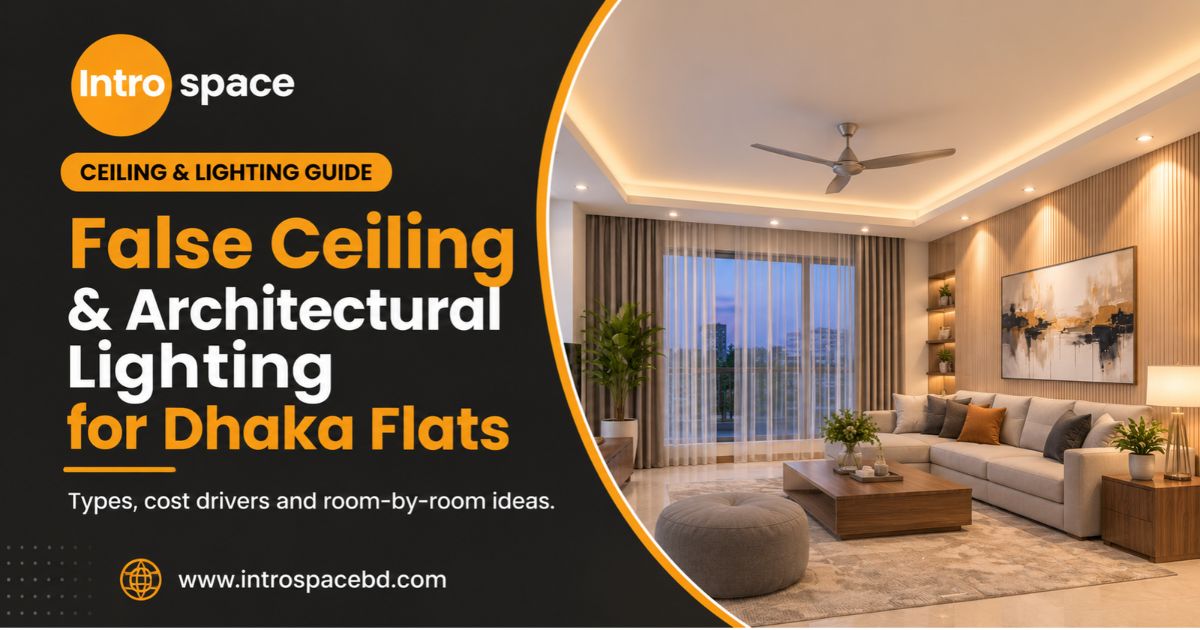
Skip the single big central light. Use a perimeter cove for soft glow, then add a few downlights over seating and a spot or two for art.
Keep the drop mostly at the edges. That way the center of the room keeps its height, and a ceiling fan still has room to breathe.
Bedroom
Keep it quiet. Warm cove light, a dimmable ceiling light, and bedside lamps are plenty.
Avoid glaring downlights above the bed. Nobody wants a spotlight in their eyes when they lie down.
Dining Area
A pendant or feature light over the table works best. A small wooden or textured ceiling panel above the table can frame the space, especially in open-plan flats where the dining area has no walls.
Kitchen
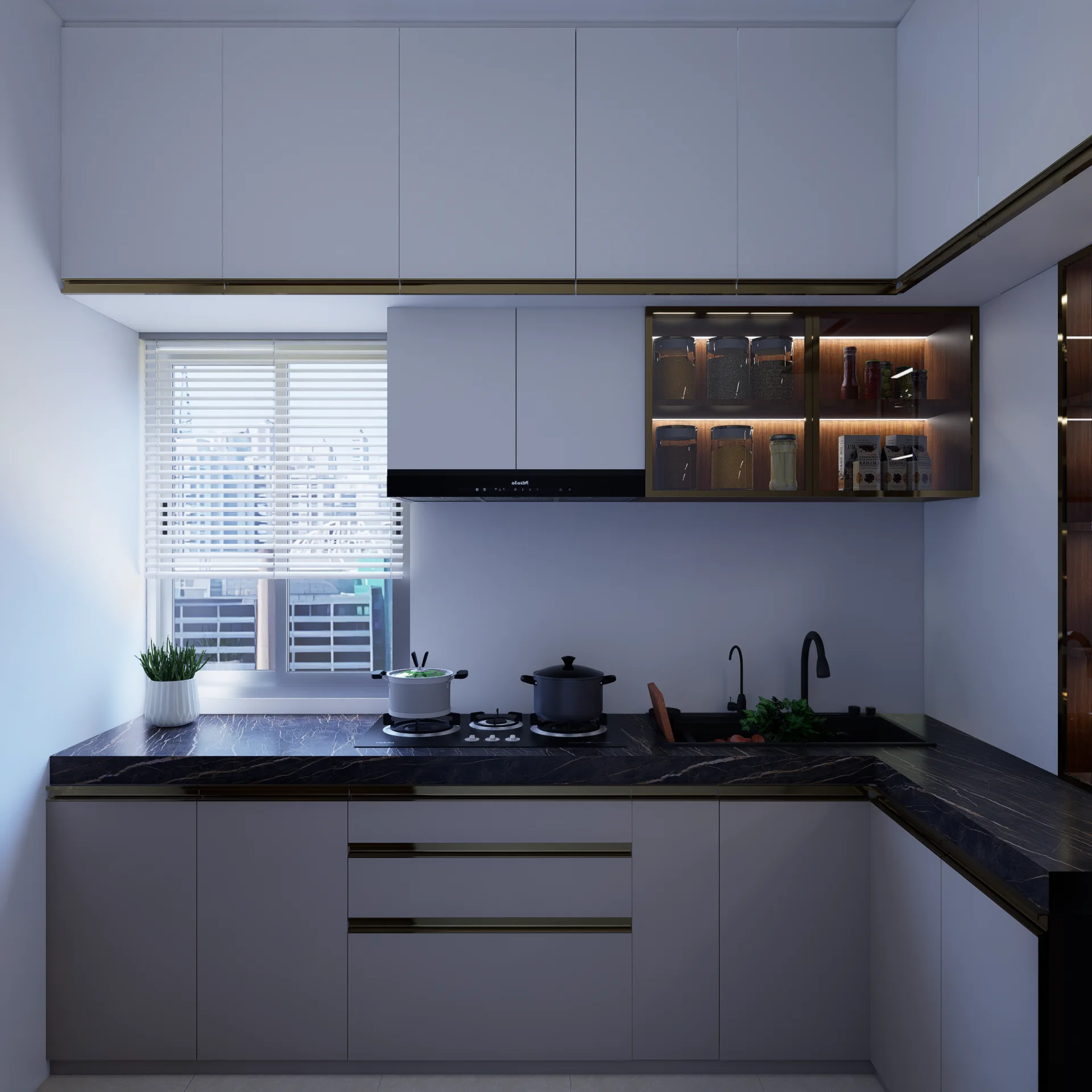
Here, function wins. Use bright, neutral, evenly spread light and under-cabinet LED strips so your counters aren’t in shadow.
Pick PVC or moisture-resistant board. Cooking steam and oil mist are hard on ordinary ceilings.
Kids’ Room
Keep fixtures safe and low-glare. Dimmable lights help at bedtime. Avoid anything with sharp edges or fragile parts.
Entry and Corridor
Narrow corridors can feel tight. A linear LED line or a few evenly spaced soft lights make the space feel longer and calmer.
Planning for Dhaka’s Real Conditions
A design that ignores local conditions fails quietly. These are the points I’d check before approving anything.
Humidity. Ask about galvanized framing and moisture-resistant board in damp areas. Leave the ceiling void able to breathe.
Water leaks. Test and repair any leak from above before you close the ceiling. A false ceiling can hide a leak until the board sags.
Ceiling fans. Fans must hang from the structural slab with a proper rod or hook that passes through the false ceiling. Never hang a fan from the board itself.
AC and service access. Leave service panels near AC indoor units and plumbing. Don’t let a cove or drop block the airflow of a split AC.
Load-shedding. If your building has IPS or generator backup, ask that a few ceiling lights sit on the backed-up circuit. A rechargeable lamp is a cheap backup too.
Voltage swings. LED drivers don’t love surges. Use decent drivers and consider surge protection. Cheap drivers are a common reason lights flicker or die early.
Safe wiring. Run wires in conduit. Keep joints in accessible junction boxes. Never bury a splice above a closed ceiling.
Building rules. Interior work rules vary by building. Check with your building management or owners’ association before you start. For planning and building questions, RAJUK is the official body in Dhaka, and the Fire Service and Civil Defence publishes fire-safety guidance.
What Does a False Ceiling Cost in Dhaka?
I’m not going to print a taka-per-square-foot figure here. Prices shift with material, brand, design complexity, and the supplier’s market rate. A number I quote today may be wrong next month, and that would waste your time.
What I can do is show you what drives the price so you can read any quote clearly.
| Cost Driver | Effect on Price |
|---|---|
| Ceiling material | Gypsum, POP, PVC, and wood all price differently |
| Design complexity | Coves, steps, and curves add labor |
| Total area and drop depth | More area and more layers cost more |
| Lighting type and quality | Branded drivers, profiles, and fixtures cost more than basic ones |
| Electrical work | Extra circuits, dimmers, or backup lines add cost |
| Finish and paint | Smooth multi-coat finishes cost more than basic ones |
| Site conditions | Hard access, tall floors, or leak repairs add work |
How to Compare Quotes Properly
Two quotes can look alike and hide big differences. Ask each contractor to confirm:
- Is the rate per square foot for material and labor?
- Are lights, drivers, and profiles included?
- Which board brand and framing type will they use?
- Is painting included, and how many coats?
- Who pays for electrical changes?
- What’s the warranty and after-service?
Ask for an itemized quote in writing. If someone refuses, that tells you something.
Step-by-Step: How to Plan Your Ceiling and Lighting
- Fix leaks and wiring problems first. Never close a ceiling over an open problem.
- Measure each room and note beams, AC positions, and fan points.
- Decide how each room will be used. Rest, work, and cooking need different light.
- Sketch a lighting layout with general, task, and accent light.
- Choose materials by room. Think humidity before looks.
- Finalize the electrical plan before framing starts.
- Approve a mock section if possible, such as a small cove, before the full job.
- Inspect before painting. Check joints, levels, and service access.
Checklist Before You Say Yes
- Leaks fixed and tested
- Ceiling height measured and drop depth agreed
- Fan and AC points marked
- Framing type and board brand confirmed
- Light color and dimming plan decided
- Driver and fixture brands named in the quote
- Service access panels planned
- Backup lighting circuit discussed
- Building rules checked
- Written timeline and payment terms agreed
Mistakes People Commonly Make
Dropping the whole ceiling. Most flats look better with a partial drop. Keep the center high and lower only the edges.
Too many downlights. More isn’t better. It creates glare and bright spots.
Ignoring ceiling fans. Fans placed after the ceiling is built often end up off-center or poorly supported.
Buying the cheapest LEDs. Poor strips and drivers flicker, shift color, or fail. You’ll pay twice.
Skipping the lighting plan. Choosing fixtures after the ceiling is finished limits your options.
Forgetting access. A fully sealed ceiling turns a small repair into a big one.
Copying a photo. A design made for a tall, wide room can overwhelm a compact Dhaka flat.
Conclusion
A good ceiling and lighting plan makes a flat feel calmer, brighter, and more finished. The best results come from simple choices: the right material for each room, fewer but better lights, and a plan that respects humidity, power cuts, and your actual ceiling height.
If you remember one thing, make it this: plan the lighting and wiring before you decide the ceiling shape. That order saves money and avoids regret.
Ready to plan false ceiling and architectural lighting for your Dhaka flat? Talk to the Intro Space team and share your room sizes. You’ll get a practical plan built around your space.
Frequently Asked Questions
Key insights and expert answers regarding this design insight